De las chinampasXochimilco · Tláhuac · Mixquic · fo. 1

In the manner of the Florentine Codex

Mexico · GIAHS 2018

Chinampas gardens built out of a lake

Farmers build gardens from lake mud, plant willows round the edges, and paddle between them in canoes.

chināmitl Nahuatl · “an enclosure of reeds” — the fence that holds a garden bed together

2,240 m above the seaNahua villagesstill feeding Mexico City

A leaf of the real thingfo. 2

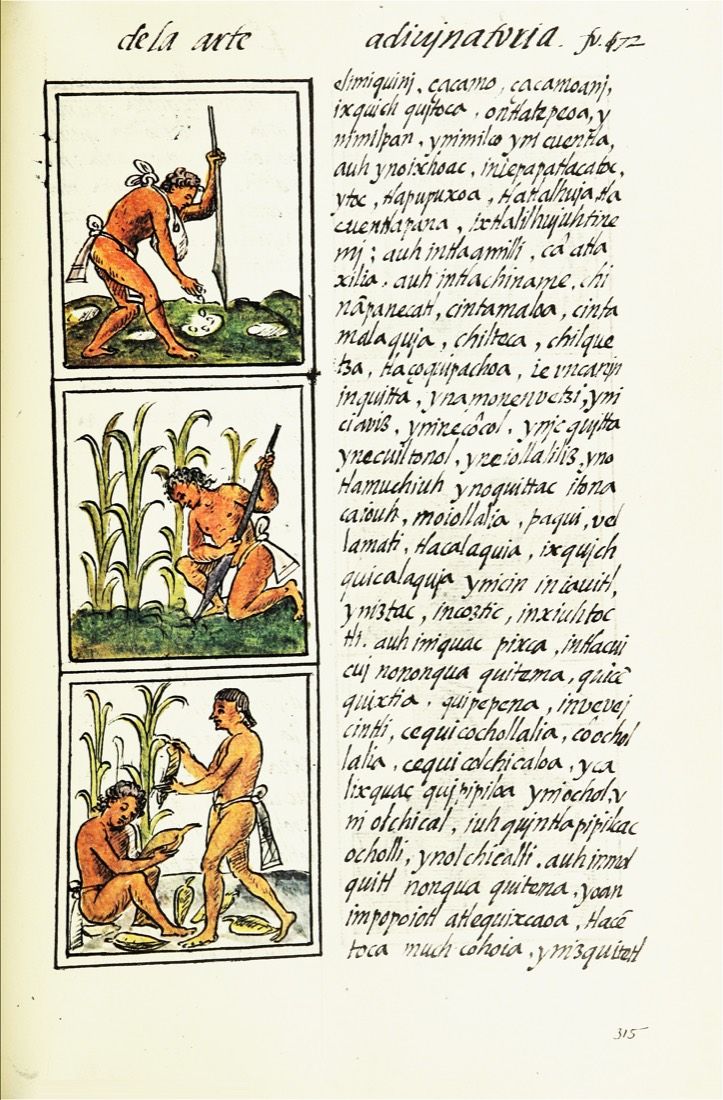
A page of the Florentine Codex: three framed pictures down the left show men planting maize with a digging stick, weeding young maize, and shelling the harvested ears. A column of handwritten Nahuatl fills the right side.
Sowing, weeding and harvesting maize. Three framed pictures and a column of Nahuatl — the same layout this page borrows. Bernardino de Sahagún and Nahua scholars and painters, Florentine Codex, Book 4, fo. 72 (1575–77). Biblioteca Medicea Laurenziana, Florence. Via Wikimedia Commons · Public domain

Gloss

About 450 years ago, Nahua scholars and painters made a huge encyclopedia of their world, in pictures and words.

Dig deeperWhat the Florentine Codex isDepth 2 of 3

The General History of the Things of New Spain was compiled between about 1545 and 1577 under the Franciscan Bernardino de Sahagún, with Nahua scholars from the college at Tlatelolco and teams of Nahua painters. Its final copy, now in the Biblioteca Medicea Laurenziana in Florence, sets Nahuatl text and Spanish text in parallel columns, with more than two thousand illustrations.

The leaf shown here is from Book 4 — its running head reads de la arte adiuinatoria. Its pictures show maize planted with a digging stick, tended and shelled. Among the Nahuatl words beside them is chinampanecatl, a person of the chinampas.

Dig deeperHow the codex draws, and how this page borrows itDepth 2 of 3

The painters worked contour first, then flat washes of mineral and plant colour, with water shown as curling blue lines and each scene boxed in a ruled frame. Book 11, “Earthly Things”, is the richest for farming: it names soils such as atlalli (irrigated land) and tepetlalli (sloping land), and describes the axolotl as good food.

Every drawing on this page follows those rules — outline, flat colour, curling water, double-ruled frame — but none copies a folio. Where it borrows a manner, it says so.

A garden, cut in halffo. 3

Slice through a chinampa

It isn't floating. It's a pile of mud and plants, held by posts and willow roots, with water on both sides that soaks up into the soil.

1 2 3 4 5 6 7 8 9
  1. The bed — layers of mud and plants
  2. The canal — a road for canoes
  3. Water soaking up — it waters itself
  4. Ahuejote willows — roots hold the edges
  5. Chapín seedbed — a mud cube for each seed
  6. Canal mud — the garden's food
  7. Axolotl refuge — a clean room for a rare animal
  8. The canoe — carries mud, seedlings, harvest
  9. Where the water comes from — springs, then treated water
One bed in cross-section. Layers, posts and willow roots after FAO, the SADER chapín guide and UNAM's refuge programme. Diagram · drawn in SVG, in the manner of the codex

“Floating gardens”? Chinampas are often called that, but they don't float. They are built up from the bottom of a shallow lake and fixed there.

The mix-up may come from the reed rafts used to carry plants and soil, or from the way the beds seem to sit on the water. Bangladesh's floating fields really do float — different idea, different page.

How to make land out of waterfo. 4

Build a garden in five pictures

You need a shallow lake, some posts, lots of reeds, a canoe, and a great deal of mud.

  1. Drive in posts

    Mark out a long, thin rectangle in the shallow water.

  2. Weave a fence

    Reeds and branches go in and out between the posts. That fence is the chināmitl.

  3. Fill with mud

    Pile lake mud and water plants in layers until the bed stands above the water.

  4. Plant willows

    Ahuejote trees along the edges grow roots that stitch the bed together.

  5. Sow in mud cubes

    Seeds start in little blocks of canal mud, then move out onto the bed.

Dig deeperSizes, dates and what the sources actually sayDepth 3 of 3

Beds are usually long rectangles. The Codex Vergara suggests about 30 × 2.5 m; beds around Tenochtitlan ran about 90 × 5–10 m; other sources give 8–100 m long and 2–25 m wide, standing roughly half a metre above the water. Canals average about 1.5 m deep and 4–6 m wide.

Montezuma cypress (Taxodium mucronatum, Nahuatl āhuēhuētl) was historically planted at bed corners too. The earliest securely dated chinampa fields are from about 1150–1350 CE, with Culhuacan around 1100 CE; FAO-related material says “around 2,000 years”, which is disputed.

Of the year, and its rainsfo. 6

JANFEBMARAPRMAYJUN JULAUGSEPOCTNOVDEC one year blue · rains, May–Oct sand · dry, Nov–Apr● July, wettest
The rains decide the year. About 700 mm a year at San Gregorio Atlapulco, roughly nine-tenths of it May–October; July is the wettest month. Diagram · drawn in SVG · climate normals 1960–90 via CONAGUA

Wet half, dry half

When it rains, the canals fill up. When it's dry, farmers scoop mud and start new seeds.

Nov – AprDry season: mud, seedbeds, romeritosDepth 1 of 3

Canal levels fall. Farmers dredge mud and build chapines. Romeritos sown in October are harvested for Christmas — the chinampa zone supplies most of Mexico City's crop — and sown again in January–February for Lent. Poinsettias sell in December.

Mar – AprThe flower festivalDepth 1 of 3

La Flor más Bella del Ejido is held around Viernes de Dolores, the Friday before Holy Week. It began on the Canal de la Viga and moved to Xochimilco in 1955, when that canal lost its water.

May – OctRains: canals refill, crops growDepth 1 of 3

Rain refills the canals, and chinampas can take diverted floodwater, acting as a buffer for the city. Maize and leafy vegetables grow through the season. Beds are replanted continuously; Wikipedia reports up to seven harvests a year, a figure that is poorly sourced.

Late Oct – 2 NovMarigolds for the Day of the DeadDepth 1 of 3

Cempasúchil (Tagetes erecta) is cut for Día de Muertos. On 2 November, San Andrés Mixquic holds its alumbrada, when families light the graves with candles. This is mourning and remembrance, not spectacle; it is described here and not illustrated.

Of the wisdom of the chinamperosfo. 7

Four clever ideas

It waters itself

Plants drink from the canal through the soil. Nobody needs to carry water.

Dig deeperSub-irrigation and flood storageDepth 2 of 3

The narrow beds sit just above the water table, so canal water moves sideways and upward through the soil by capillarity — the system has been described as an ancient sub-irrigation scheme. In the rainy season the canals and beds act as regulating reservoirs, taking diverted floodwater; the wetland stores water with less evaporation than an open reservoir and makes the local climate more humid.

It recycles the lake

Old mud from the canal bottom becomes new food for the garden.

Dig deeperDredging as fertiliser, and as maintenanceDepth 2 of 3

Dredged sediment, rich in decayed plant and animal matter, rebuilds bed height and fertility — and dredging also keeps the canals deep enough for canoes. The same mud becomes the chapín: poured into a bed, left 24 hours to set, cut into cubes of 4–11 cm and dibbled with a seed each, so little or no bought seed-starting mix is needed. Seedlings go out at about 8 cm.

Small space, big harvest

Tiny gardens feed lots of people, again and again through the year.

Dig deeperWhat the chinampa zone producesDepth 3 of 3
Crop (one reported year)Tonnes
Lettuce7,453
Purslane3,334
Romeritos3,132
Chard1,352
Ornamental plants23–24 million plants

FAO Mexico headlined the total as “more than 19,000 tonnes of food”. Claims of seven harvests a year, or eight times the yield of conventional land, circulate widely but are poorly sourced. Only 418 ha of open field plus 98 ha under greenhouse or shade net were recorded in use.

A farm that is also a wetland

Birds, fish and axolotls share the canals with the farmers.

Dig deeperWhy a greenhouse isn't a substituteDepth 2 of 3

FAO records 51 domesticated and 96 non-domesticated plant species in use — wild plants mostly as fodder (67%), medicine (20%) and food (13%). Merlín-Uribe et al. (2012) found greenhouses more profitable than chinampas, but unable to replace their ecosystem services: willow cover goes, canals are filled, and the wetland stops working as one.

Of the people of the lakefo. 8

The chinamperos

Families in the old villages of the lake still build and farm the beds, sell greens in the city, and hold flower festivals on the water.

Dig deeperFood from the bedsDepth 1 of 3

Romeritos, traditionally cooked in mole for Christmas and Lent; quelites (wild and semi-wild greens); purslane; maize. In the 16th century the codex described the axolotl as good food — today it is protected, and eating it is part of why it declined.

Dig deeperFestivals, described with careDepth 2 of 3

La Flor más Bella del Ejido is a flower pageant on the water. Xochimilco's villages keep dozens of fiestas through the year. The Niñopa, a revered image of the Christ Child, has around 25,000 followers who host and care for it in turn. In Mixquic, Día de Muertos is marked with a candle-lit alumbrada in the cemetery, carrizo-reed stars and home ofrendas.

These are religious and family observances. This page describes them and deliberately does not draw them.

Dig deeperWho owns and runs the chinampasDepth 3 of 3
  • Land is held both as private property and as ejido (communal agrarian land). Since the 1992 agrarian reform, ejido land can be privatised and sold, which has fed informal urbanisation.
  • Water is shared among parajes — local farm districts, 18 of them in San Gregorio Atlapulco alone — and users build small dams to move it around.
  • The heritage zone is managed by Mexico City's Authority for the World Heritage Zone in Xochimilco, Tláhuac and Milpa Alta, which requested the GIAHS designation.
  • The area is also a Natural Protected Area (1992), part of the UNESCO World Heritage site “Historic Centre of Mexico City and Xochimilco” (1987) and a Ramsar wetland (2004).
Dig deeperWho does the workDepth 2 of 3

A 2007 census of producers in the protected-area chinampas counted 307: 92% men, 45% aged 31–50, and 36.7% born in other states — much of the labour now comes from migrants. Women's roles in selling and processing were not quantified, though women have used the flower pageant as a platform to speak up.

Of the dangersfo. 9

Under pressure

The city is growing onto the gardens. The canals are dirtier. The land is sinking. The axolotl has almost disappeared from the wild.

17%of the 20,922 chinampas still farmedFAO data 2018 · via Mongabay
6,000→35axolotls per km², 1998 to 2014UNAM surveys · via Mongabay
31 haof chinampa zone lost every yearPérez-Belmont et al. 2021
≈18 cmthe ground sinks each year as the aquifer is pumpedWikipedia · medium confidence
Dig deeperWhat is going wrongDepth 2 of 3
  • Abandonment: about 16,000 chinampas are abandoned in Xochimilco; the value of production fell 60% between 2012 and 2019.
  • Urbanisation: 308 irregular settlements in the conservation area hold 17,803 homes and 133,523 people on 569 ha. About a quarter of the wetland has been built on since the mid-20th century.
  • Water: the springs that fed the lake were piped to Mexico City until they ran dry in 1951; since then the canals have been fed with wastewater, now treated at Cerro de la Estrella. Untreated discharges still enter. Falling water cracks beds; stagnant water spoils crops.
  • Greenhouses: plastic houses replace chinampas, willows are cut and canals filled.
Dig deeperWhat is being triedDepth 2 of 3
  • The GIAHS action plan set strategies for each of the five chinampa zones: rehabilitating canals and soils, reforestation, restoring flooded areas and village heritage.
  • UNAM's Chinampa-Refugio programme has rehabilitated 40 chinampas and built 36 refuge canals and 71 biofilters, supporting 228 families.
  • The Etiqueta Chinampera (2022) certifies produce from farmers who keep refuge canals and farm without agrochemicals; 18 farmers held it in 2024.
  • The ADOPTAXOLOT campaign drew more than 2,800 donations in 2024–25.
GIAHSHow it meets FAO's five criteriaDepth 1 of 3
  • Food & livelihoodsThousands of tonnes of vegetables a year for Mexico City, plus ornamentals and jobs.
  • Agrobiodiversity51 domesticated and 96 wild plant species in use; a domestication centre for purslane and romeritos; the axolotl.
  • KnowledgeBed building, dredging, the chapín and water sharing between parajes, passed on by word and practice.
  • Culture & organisationOriginal villages, their fiestas, and ejido and paraje institutions.
  • LandscapeA grid of beds, canals and willow rows, mapped since at least the 16th century.

Summary of this chapterfo. 10

Where
Southern Mexico CityXochimilco, Tláhuac, part of Milpa Alta
Centre
19.28° N, 99.07° WRamsar wetland
Altitude
≈ 2,240 mthe Valley of Mexico lake plain
Area
≈ 2,215 hachinampa zone, FAO proposal
Beds
20,922about 17% farmed
Canals
≈ 170 kmXochimilco network
Rain
≈ 700 mm a year~90% May–October
People
Nahua-descended villagesSan Gregorio, San Luis, Tláhuac, Mixquic…
Designated
GIAHS 2018UNESCO 1987 · Ramsar 2004

Field notebook

Every note on this page · open

The garden · 1

The bed

A long garden built up from lake mud, with water all around it.

Rectangular platforms of stacked lake-bottom mud and plant matter, fixed to the lake bed — not floating. They were built by driving posts, weaving reeds and branches between them, and filling with layers of mud. Sizes vary from roughly 30 × 2.5 m to 90 × 10 m; beds stand about half a metre above the water.

The garden · 2

The canal

A water road for canoes, between the gardens.

Canals average about 1.5 m deep and 4–6 m wide; the Xochimilco network runs about 170 km. The main canal is locally an acalote; the small ditches between beds are apantles. In San Gregorio Atlapulco, 205.5 km of canal remain, but only 27% are deep enough to navigate.

The garden · 3

Water that soaks upward

The plants drink from the canal through the soil.

Because the bed is narrow and low, the water table inside it is the canal's own level. Water rises by capillarity into the root zone — sub-irrigation — so beds rarely need watering by hand.

The garden · 4

Ahuejote willows

Salix bonplandiana · Nahuatl āhuexōtl

Tall skinny trees whose roots hold the garden edges together.

Planted along the edges, the roots stop the bed eroding into the canal, the trees break the wind, and they give cover where aquatic animals breed. Where greenhouses replace chinampas, ahuejotes are cut first.

The garden · 5

The chapín

Tiny squares of mud, each one a bed for a single seed.

Mud dredged from the canal is carried by canoe and poured into a seedbed (almácigo), left 24 hours, cut into cubes, dibbled, sown, dusted with soil or compost and covered with grass. Cubes are 4–11 cm depending on the crop; seedlings are transplanted at about 8 cm.

Source
SADER Mexico City, 2022

The garden · 6

Canal-bottom mud

Farmers scoop dark, rich mud from the canal to feed their plants.

The same dredged sediment top-dresses the beds, returning nutrients washed into the canal to the soil — and dredging keeps the canals open for boats.

The garden · 7

Axolotl refuge

A clean, quiet water room where axolotls can live safely.

A modern restoration element. Under the Etiqueta Chinampera, refuge canals are at least 1.5 m deep and 1.2 m wide, with a biofilter of volcanic stone, wood and native plants at each end to clean the water and keep out carp and tilapia.

The garden · 8

The canoe

Flat wooden boats carry mud, seedlings and vegetables.

Canoes carry mud to the seedbeds and harvests out. Until the electric tram reached Xochimilco in 1908, trajineras were the main way to move people and produce to city markets such as La Merced and Jamaica.

The garden · 9

Where the water comes from

The water once came from springs; now much comes from a cleaning plant.

Springs that fed the lake were piped to Mexico City from the late 19th century until they ran dry in 1951. Since then the canals have received wastewater, now treated at the Cerro de la Estrella plant — secondary effluent from 1971, tertiary from 1994.

Animal

Axolotl

Ambystoma mexicanum · Nahuatl axolotl

A salamander that stays young all its life and lives only in these canals.

Endemic to the lake system and Critically Endangered on the IUCN Red List. Survey densities fell from about 6,000 per km² in 1998 to 100 in 2008 and fewer than 35 in 2014; one 2009 study found a single individual across its study area. The Florentine Codex (Book 11) describes it as good food.

Tree

Ahuejote

Salix bonplandiana

A thin, tall willow planted along every garden edge.

Its columnar shape casts little shade on the crops; its roots bind the bed. IUCN Least Concern as a species, but disappearing locally wherever chinampas are converted.

Tree

Ahuehuete

Taxodium mucronatum · āhuēhuētl

A huge old cypress tree that loves wet ground.

Mexico's national tree; historically planted at the corners of beds alongside the ahuejote as a stabiliser.

Crop

Maize

Zea mays · tlaōlli (shelled maize)

Corn — the old staple food of the chinampas.

The Florentine Codex mentions the white maize of the chinampas. Over the 20th century the beds shifted from staples toward commercial vegetables and flowers.

Crops

Beans, squash, amaranth, chilli, tomato

etl, ayotli, huauhtli, chilchotl, xitomatl

The Mesoamerican mix of crops that grow happily together.

All named together in an early 17th-century Nahuatl account of fence-building and planting — the polyculture that also underpins the Maya milpa.

Crop

Romeritos

Suaeda sp. (species uncertain)

A salty little green cooked with mole at Christmas.

San Gregorio Atlapulco is a centre of its semi-domestication. More than 3,000 t are harvested, much of it for December, with a second sowing for Lent.

Crop

Purslane

Portulaca oleracea · verdolaga

A juicy, crunchy leaf you can eat raw or cooked.

San Gregorio Atlapulco is described as a domestication centre. About 3,300 t in one reported year.

Crop

Lettuce

Lactuca sativa

The crop that makes the most money today.

About 7,450 t in one reported year. Lettuce, romeritos, purslane and chard together make up roughly 80% of output.

Flowers

Marigold and poinsettia

Tagetes erecta (cempasúchil) · Euphorbia pulcherrima (nochebuena)

Orange flowers for the Day of the Dead; red ones for Christmas.

23–24 million ornamental plants a year, many now in greenhouses — which is part of the pressure on the chinampas.

Trouble

Carp and tilapia

Cyprinus carpio, tilapias

Fish brought from far away that eat axolotl eggs and babies.

Introduced fish are one of the main pressures on the axolotl. Refuge-canal biofilters are designed to keep them out.

People

Chinamperos

The farmers who build and look after the beds.

About 12,500 people are reported to farm in the GIAHS zone. A 2007 census of producers in the protected area counted 307, mostly men, a third from other states.

Tool

The canoe

A boat that is the chinampa's truck, tractor and taxi.

Mud, seedlings, harvests and people all move by water. The painted trajineras that carry visitors today descend from the working boats.

Contested

2017 or 2018?

Both, depending on what you count.

FAO's GIAHS page gives 2017, when FAO notified the city (10 July 2017) that requirements were met. The certificate was presented at FAO in Rome on 19 April 2018. This atlas follows the list it was built from, which says 2018.

Contested

How big?

Depends where you draw the line.

  • 2,215 ha of chinampa zone — FAO proposal, about 30% of the 7,534 ha World Heritage zone.
  • 4,336 ha of productive chinampas — Pérez-Belmont et al. 2021, citing González-Pozo 2016.
  • 2,657 ha — the Ramsar site.

Contested

How many chinampas?

Lots — but counts differ.

20,922 (FAO data, 2018) against “about 5,000 still in their original form” (Wikipedia). Share still farmed: 17% or 19%, depending on the source.

Contested

How old?

Hundreds of years for sure — maybe much more.

FAO-related material says “around 2,000 years”. The earliest securely dated chinampa fields are from about 1150–1350 CE, with Culhuacan around 1100 CE.
Sources

  1. FAO GIAHS. Chinampas Agricultural System in Mexico City, Mexico. fao.org/giahs
  2. FAO Mexico. Chinampas de la Ciudad de México producen más de 19 000 toneladas de alimentos (page since removed).
  3. Pérez-Belmont P. et al. The survival of agriculture on the edge: Perceptions of push and pull factors for the persistence of the ancient chinampas of Xochimilco. Journal of Rural Studies 86 (2021).
  4. Merlín-Uribe Y. et al. Environmental and socio-economic sustainability of chinampas (raised beds) in Xochimilco. Int. J. Agricultural Sustainability (2012).
  5. Getty Research Institute. Digital Florentine Codex, Book 11 (fos. 68r, 227v–228r).
  6. SADER Ciudad de México. El chapín, técnica de siembra ancestral (2022).
  7. Mongabay (2024). Scientists and farmers restore Aztec-era farms that house axolotls; Ancient farming system and campesino livelihoods at risk in Mexico City.
  8. UNAM DGCS. Boletín 393/2025 on ADOPTAXOLOT and the Etiqueta Chinampera.
  9. Contreras V. et al. (2009). Axolotl survey, Biological Conservation. IUCN Red List: Ambystoma mexicanum.
  10. Wired Humanities Projects, University of Oregon. Online Nahuatl Dictionary: chinamitl.
  11. Ramsar Sites Information Service. Sistema Lacustre Ejidos de Xochimilco y San Gregorio Atlapulco (1363).
  12. Wikipedia (English and Spanish): Chinampa, Xochimilco — for cross-checks and climate normals.

Last reviewed September 2026 · Research dossier: research/chinampa.md · Spot an error? Corrections from chinamperos are especially welcome.

Latin America · 7

Europe · 10

North Africa · 8

East Africa · 3

West Asia · 7

South Asia · 5

Southeast Asia · 2

East Asia · 42